Chemical Reactions
S2 lessons on chemical and physical changes, word equations, formulae, reaction rates, electrolysis and chemical cells. Choose a lesson to open it.
- Lesson 1Chemical Reaction or Physical Change?
- Lesson 2Chemical Reactions
- Lesson 3Writing Word Equations
- Lesson 4Introduction to Formulae and Structure
- Lesson 5Reaction Rates: Concentration
- Lesson 6Reaction Rates: Particle Size
- Lesson 7Reaction Rates: Temperature
- Lesson 8Reaction Rates: Catalysts
- Lesson 9Electrolysis
- Lesson 10Researching Electrolysis
- Lesson 11Chemical Cells
- Lesson 12Graph Drawing Skills
Lesson 1 - Chemical Reaction or Physical Change?
Learning Intentions
- Be able to tell the difference between Physical and Chemical reactions.
- Be able to give an example of at least one chemical and Physical reaction.
- What is a Chemical Reactions?
- What is a Chemical?
- What is a Reaction?
Do pretest
Chemical or Physical Change?
Watch the video below. It should help you to decide the difference between a chemical and a physical change.

Notes - Chemical or Physical Change
A change in which a new substance is made is called a "chemical change".
e.g. When you burn methane gas, the methane and oxygen change into new substances: carbon dioxide and water.
A physical change does not make anything new but may involve the original substance changing state e.g. from a solid to a liquid.
Melting, boiling, evaporating and condensing are all examples of physical changes.
Physical or Chemical
Decide if the following are physical changes or chemical reactions.
1. Melting ice is a...

2. Dissolving sugar in tea is a...

3. Making toast is a...

4. Water boiling is a...

5. A candle burning is a...

6. Water evaporating is a...

7. Burning wood in a fire is a...

8. A turkey cooking is a...

9. Making ice in a freezer is a...

10. Making steel from iron ore is a...

Lesson 2 - Chemical Reactions
Learning Intentions
- I will know the signs that a chemical reaction has happened.
Chemical reactions
The video below shows lots of examples of chemical reactions. Note the differences between the reactants and products.
Activity - Chemical Reactions
Do the five experiments and fill in the worksheet.
- What does the substance(s) look like before?
- What does it/they look like after?
- What did you see happen?
- Did anything else happen?
Notes - Signs of a Chemical Reaction
- Colour Change
- Gas Given off
- Temperature Change
- Change in Smell
- Solid Formed
Lesson 3 - Writing Word Equations
Learning Intention
- Use word equations to describe chemical reactions
Chemical Reactions
Watch the three videos below of chemical reactions.
Burning Sulfur
Exploding Balloon
Burning Methane
Experiment - Making Hydrogen
Collect the following equipment:
- a test tube and rack
- safety mat and goggles
- Bunsen burner
- hydrochloric acid
- magnesium
- wooden splint
Instructions
- Add one piece of Magnesium ribbon to 2cm of Hydrochloric acid in a test tube.
- Use your finger to cover the top of the test tube.
- Place a burning splint to the mouth of the test tube to test for hydrogen.
- Write a description, in as much detail as possible, of what you did and what you saw.
Notes - Word Equations

Work through the handout and write down the word equations.
Activity - Identifying Reactants and Products
Complete the word equations for the chemical reactions below.

Extension - Writing Word Equations
Write the word equations for the reactions below.
Experiment 1
A piece of magnesium ribbon is added to hydrochloric acid. Magnesium chloride and hydrogen are produced.
Experiment 2
The hydrogen gas from experiment 1 is collected. It is burned in oxygen. This produces water.
Homework 1 - Chemical Reactions
Complete the forms quiz below.
Lesson 4 - Introduction to Formulae and Structure
Learning Intentions
- Recognise some of the most common formulae - H2O, O2, CO2
- Understand that the letters represent the elements present and the numbers show how many of the preceding element are present.
Is J2O a chemical formula?

Where does the name come from?
What does O2 really mean?

Notes - Chemical Formulae and Structure
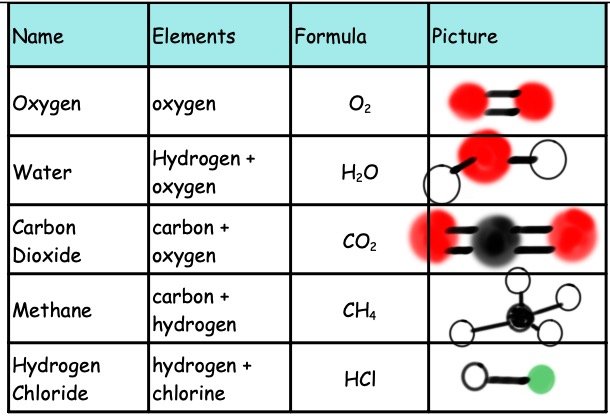

Activity - Mollymods
The diagram below shows which elements are represented by each colour.

Use the bonds to try and make the molecules in the table.
You can use the short bonds or the bendy ones.
All the holes on each atom must be filled
| Name | Elements | Formula | Picture |
|---|---|---|---|
| Oxygen | O2 |

|
|
| Water | hydrogen and oxygen |

|
|
| Carbon Dioxide | CO2 |

|
|
| Methane | carbon and hydrogen |

|
|
| Hydrogen Chloride | HCl |

|
Activity - Chemical formulae contain letters and numbers
- What do the letters represent and where do they come from?
- What do the numbers represent?
- How should the numbers be written?
Lesson 5 - Reaction Rates: Concentration
Learning Intentions
- What concentration means.
- How concentration affects the rate of a chemical reaction.
Activity - Concentration
Click on the simulation below to find out how adding solute affects the concentration.
Notes - Concentration
Increasing concentration means dissolving more particles into a solution.
Diluting means adding more water.
Experiment - Concentration and Rate of Reaction
- Aim: to find how the concentration of the acid affects the rate of reaction.
- We are going to add about 3 cm3 of hydrochloric acid to one spatula of marble chips in a boiling tube.
- We will time how long it takes to produce 10cm3 of gas.

Notes - Concentration and Reaction Rate
For any chemical reaction to happen particles must collide with each other.
The more people in a room the more chance you will bump into someone. It's exactly the same in a chemical reaction.
Increasing the concentration makes reactions go faster because there are more collisions.
Lesson 6 - Reaction Rates: Particle Size
Learning Intentions
- To find out how particle size affects reaction rate.
- To be able to explain why this happens.
- Why do you cut up potatoes before boiling them?
- Why are we told to chew our food up well before swallowing?
Experiment 1: Burning Iron
- We are going to heat an iron rod in a bunsen.
- Next we are going to sprinkle some iron filings into a bunsen flame.
- Write down what you did AND what you saw happen (observed)
- What was the difference? WHY?
Experiment 2: Burning Magnesium
- Burn a magnesium strip in a Bunsen flame. Do not stare at the flame.
- Describe what you think will happen when magnesium powder is burned, and explain why.
Notes - Particle Size and Reaction Rate
For any chemical reaction to happen particles must collide with each other.
The only part of a particle that can be hit is the outside. The amount of a substance that can be hit is called the "surface area"
If you break up a large lump into smaller pieces you increase the surface area allowing more collisions to happen.
This is why everything will react faster if you break it into smaller pieces.
Lesson 7 - Reaction Rates: Temperature
Learning Intentions
- To find out how temperature affects reaction rate.
- To be able to explain why this is the case.
Experiment - Temperature and Rate of Reaction
| Temperature (oC) | Time for tablet to disappear (s) |
|---|---|
Notes - Rate and Temperature
Increasing temperature has 2 effects.
It speeds up the particles and so increases the number of collisions that occur.
More importantly, for particles to react they must collide with enough force or they just bounce off each other. Because the particles are moving faster there are far more successful collisions.
Lesson 8 - Reaction Rates: Catalysts
Learning Intentions
- To find out how catalysts affect chemical reactions
- To be able to explain how catalysts work.
Notes - Catalysts and Reaction Rate
For any chemical reaction to happen particles must collide with each other.
Catalysts give the particles an easier way to react, for example by holding them on their surface so that more of the collisions are successful.
Catalysts speed up the rate of a chemical reaction. Catalysts are not used up. Catalysts can be biological, called enzymes.
Notes - Catalysts in Industry
- Products can be made more quickly, saving time and money.
- Catalysts reduce the need for high temperatures, saving fuel and reducing pollution.
- Catalysts are used in every car.
- Catalysts are also essential for living cells. Biological catalysts are special types of protein called enzymes.
Lesson 9 - Electrolysis
Learning Intention
- To know what the term electrolysis means.
- To understand how electrolysis works.
Notes - Electrolysis
Electrolysis happens when electricity is used to break up a compound into its separate elements.

Activity - Electrolysis
Collect the following equipment:
- Safety mat and goggles
- A small beaker
- Two leads and crocodile clips
- A power pack
- A lid
- Two black rods
- Copper chloride solution
Set it up as in the diagram below.

Results
What do you see?
What do you smell?
Activity - Breaking up Compounds with Electricity
Watch the video below on electrolysis. Answer the questions that appear throughout the video.
Lesson 10 - Researching Electrolysis
Learning Intentions
- What is electrolysis used for in the real world?
Lesson 11 - Chemical Cells
Learning Intentions
- To be able to design simple chemical cells.
- To use experiments to investigate what factors affect the voltage produced from simple chemical cells.
Electrocuting Frogs

Luigi Galvani (1737- 98) was an Italian trained in medicine and interested in physics.
His interest in anatomy and physics led him to look at the effect of electricity on the muscles of animals, particularly frogs.
The process of galvanising is named after him.

He sometimes used electricity from thunderstorms and attached the frog's legs to iron fences and other large metal objects.
He found that by connecting two different metals into the frog's legs, the muscle contractions occurred without any apparent source of electricity.

He thought the electricity was in the nerve juices in the muscles.

Another Italian, Alessandro Volta, realised that it was the two metals themselves which were generating the electricity to cause the nerve contractions in the muscles.
The term voltage and the units volts are named after him.
Experiment - Electrochemical Cells
This is a similar experiment to the one Galvani did using some 'Nerve Juice' and two different metals (but not frog's legs).
Instructions
- Copy the table below
- Copy the diagram below
- Collect the equipment, including a safety mat.
- Place the cuvette in a clamp stand so the bottom of the cuvette rests on the base of the clamp stand.


Note - Simple Electrochemical Cells
When two different metals are connected like this to produce electricity, we say we have made an electrochemical cell, sometimes just called a cell.
More than one cell connected together is called a battery.
The word battery is often used, incorrectly, instead of cell.
Extension - Lighting up
Challenge 1
Can you get one of your cells to power a buzzer?
Which cell will you choose?
Results
Metals chosen: _________ and ______
Solution chosen: ____________
Challenge 2
How many LEDs can you get to light up all together?
Will one cell make them all light up or will you need more?
Results
Draw a circuit diagram for your circuit.
Watch the video below on the history of the electrochemical cell.
Lesson 12 - Graph Drawing Skills
Learning Intentions
- To be able to draw a bar graph.
- To be able to draw a line graph.
- You may be able to create your own scale.
Activity - Bar Graphs
Grant observed the colour of trainers pupils were wearing in the Science corridor. Here are his results:

Using graph paper, display this data in a bar chart.
Activity - Line Graph
The table below shows how quickly a beaker of water was heated up using a Bunsen Burner.

Using graph paper, plot the information as a line graph.